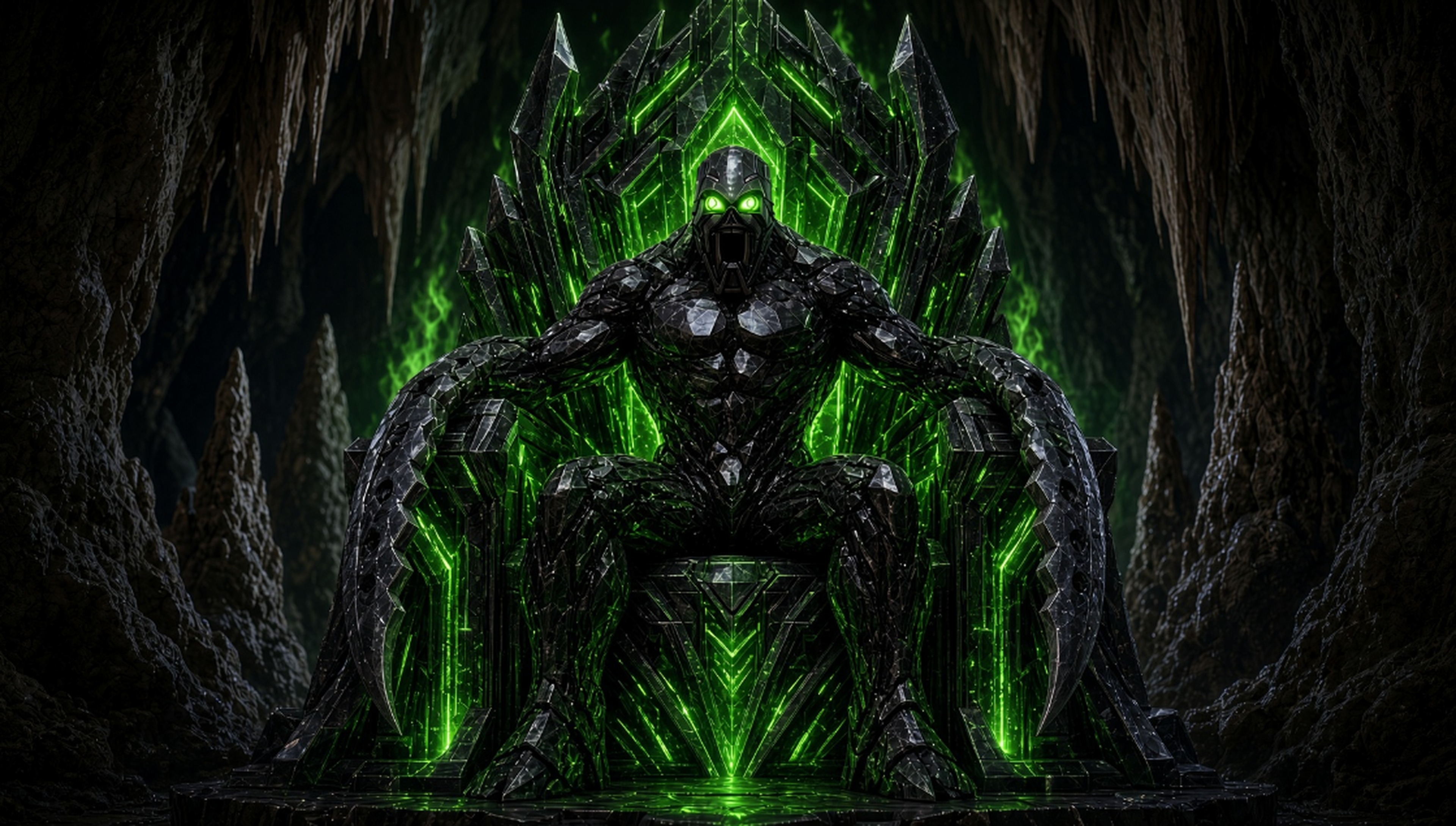
Boron
Metalloids · Saga species: Metalloid
Boron is a metalloid chemical element with symbol B and atomic number 5.
Story scene
Boron — Emerald Legion
On his black crystal throne deep in the cavern, Boron roars and raises his clawed arms. Jagged green lightning arcs from his hands, his body and the throne itself, lighting the whole cave. As the flashes fade, a glowing green mist rolls across the floor, and armored warriors with eyes like his rise out of it, carrying shields and axes. Boron settles back onto his throne as his new guard stands ready in front of him.
The science behind the story: real boron forms extremely hard dark crystals, second only to carbon among the elements, and boron compounds burn with a green flame. The summoning of armored warriors from glowing green mist is fiction.
From the Periodic Table Kings files
Written by Terrence Oneal for the original Periodic Table Kings pages.
History
Boron is a chemical element with the symbol B and atomic number 5. (1) The discovery of boron is attributed to both French and English chemists researching borate minerals in the early 19th century. (1)
The element was first isolated in 1808 by the English chemist Sir Humphry Davy and independently by French chemists Joseph Louis Gay-Lussac and Louis Jacques Thénard.
about 50% purity by reducing boric acid (H₃BO₃ or B(OH)₃) with sodium or magnesium. (3)
The pure form of boron was isolated by Henri Moissan, a French chemist, in 1892. (4) Later, in 1909, almost 100% pure boron was isolated by Ezekiel Weintraub. (4)
Boron minerals, often referred to as borates, had already been used by humans for centuries before the discovery of the element. (2) The name borax has been originated from ‘buraq’ (Arabic)
Boron is a chemical element with the symbol B and atomic number 51. Here are some of its key properties In its crystalline form, boron is a brittle, dark, lustrous metalloid. (2) It is hard enough (9.3 on Mohs scale) to scratch some abrasives, such as carborundum, but too brittle for use in tools. (3)
Boron is a semimetal of Group 13. (3) It has various crystalline forms, stable isotopes, and nuclear applications. (3)
Boron is a semiconductor, i.e., it conducts electricity like a metal at high temperatures and is almost an insulator at low temperatures. (3)
In the form of boric acid or borates, traces of boron are necessary for growth of many land plants and thus are indirectly essential for animal life3. Typical effects of long-term boron deficiency are stunted, misshapen growth. (3)
Boron is widely used in industry. It is used to increase hardness in steel, as a deoxidizer in copper-based alloys and high-conductance copper as a degasifier, and in aluminum castings to refine the grain. (3) In the semiconductor industry, small, carefully controlled amounts of boron are added as a doping agent to silicon and germanium to modify electrical conductivity. (3)
Boron is a semiconductor, meaning it conducts electricity like a metal at high temperatures and is almost an insulator at low temperatures. (1)(2) This property makes it useful in the semiconductor industry, where small, carefully controlled amounts of boron are added as a doping agent to silicon and germanium to modify electrical conductivity. (1)
Boron is hard enough (9.3 on Mohs scale) to scratch some abrasives, such as carborundum, but it is too brittle for use in tools. (1)(2)
Boron is similar to carbon in its capability to form stable covalently bonded molecular networks. (3) Even nominally disordered (amorphous) boron contains regular boron icosahedra which are bonded randomly to each other without long-range order. (3)
The boron mineral ulexite exhibits natural fiberoptic properties2. Elemental boron transmits portions of infrared light. (2)
Boron is insoluble in water, which is valuable for a variety of chemical processes. (4)
Boron has a relatively low melting point, making it useful in metallurgy and construction. (4)
molecule containing boron. (1) The green band centered at 547 nm has puzzled spectroscopists for a while. (1) Even elemental boron, when burnt properly, can generate this characteristic color which is often seen with boron and alcohol solutions. (1)
As for its use as a flame retardant, boron-based flame retardants are used in many polymer and cellulosic based products where flammability poses a serious threat. (5) If a fire ignites, borates form a carbonaceous char and provide a protective vitreous layer that strengthens and stabilizes the char. (5) This vitreous protective layer acts as an insulator, slows pyrolysis, and creates a barrier to hinder the release of additional gases that can fuel combustion. (5) Boron compounds can also form glassy films that may inhibit mass transfer of combustible vapors. (6) Boron-based fire retardant coatings are non-flammable chemicals that can help prevent a building from catching on fire. (7) They react with inorganic materials to produce an arid, hard finish and can be safely applied onto combustible surfaces such as wood or metal sheathing. (7)
The most widely used commercial process for producing boron is the Moissan process, which involves the reduction of boric oxide with magnesium1. This process yields 90–92% pure boron, which is then leached with acid to separate it from the magnesium oxide formed during the process, followed by multiple washes and drying. (1)
Pure boron can be prepared by reducing volatile boron halides with hydrogen at high temperatures. (2)(3)
Ultrapure boron for use in the semiconductor industry is produced by the decomposition of diborane at high temperatures and then further purified by the zone melting or
The production of boron fiber by chemical vapor deposition takes place in a borosilicate glass reactor.4 A 0.0005-inch (12- µm) diameter tungsten substrate is introduced through a mercury-sealed gas inlet and drawn through the reactor. The substrate is resistively heated to 1,300° C by a DC power supply while boron trichloride and hydrogen are introduced at the top of the reactor. As the tungsten passes through the reactor, boron is formed on the substrate by the hydrogen reduction of the boron trichloride. (4)
These methods are used to produce boron for various applications, including the production of high-strength, lightweight materials that are used chiefly for advanced aerospace structures as a component of composite materials. (5)
These include compounds like boron trifluoride (BF3), boron tribromide (BBr3), and boron trichloride (BCl3). They are known for their reactivity and are often used as catalysts. 1
Boron forms several oxides and borates. Some of the most common ones include borax (Na2B4O7), boric acid (H3BO3), and boron oxide (B2O3). These compounds are often found in nature.
These are compounds of boron and hydrogen with the generic formula BxHy. Examples include diborane (B2H6), pentaborane (B5H9), and decaborane (B10H14). 1
Boron nitride (BN) is a notable compound that can adopt a variety of structures. 1
Boron combines with various metals to form a class of compounds called borides. 2
An extremely hard substance used as an abrasive and as a reinforcing agent in composite materials 2.
Toxicity
Boron is generally safe when consumed in foods and beverages. However, it can become toxic when taken in higher doses. (1)
In severe cases, boron toxicity can cause male fertility problems (1) and even death. (4)(5) These symptoms are more likely to occur if a person accidentally swallows cleaning products or pesticides that contain certain forms of boron, such as borax (sodium borate) or boric acid. (4)(5)
It’s important to note that the body maintains boron homeostasis, likely by increasing urinary excretion. (3) However, very high amounts of boron can overwhelm this mechanism and lead to toxicity. (3)
If you suspect boron toxicity, it’s important to seek medical attention immediately. Always consult with a healthcare provider before starting any new supplement regimen. It’s also crucial to keep cleaning products and pesticides out of reach of children to prevent accidental ingestion. (4)(5)
The discovery of francium completed humankind’s discoveries of naturally occurring elements. All elements discovered since then have been discovered when the element has been produced in the laboratory.
Commercially, there are no uses for francium, due to its rarity and instability. It is used for research purposes only. Francium has been studied most recently at Stony Brook University, New York.
Scientists there trapped up to ten thousand francium atoms at a time using laser beams in a magnetic field in order to measure their properties.
Boron is a metalloid, intermediate between metals and non-metals. It exists in many polymorphs (different crystal lattice structures), some more metallic than others. Metallic boron is extremely hard and has a very high melting point. Boron does not generally make ionic bonds, it forms stable covalent bonds.
Although opaque to visible light, boron can transmit portions of infrared light. Boron is a poor room temperature conductor of electricity but its conductivity improves markedly at higher temperatures.
Elemental boron is not known to be toxic. Boron is an essential nutrient for all green plants. Boron in its crystalline form is very unreactive. Amorphous boron is reactive.
Boron is a tough element – very hard, and very resistant to heat. In its crystalline form it is the second hardest of all the elements on the mohs scale – only carbon (diamond) is harder. Only 11 elements have higher melting points than boron: these are C, W, Re, Os, Ta, Mo, Nb, Ir, Ru, Hf, and Tc.
Boron is used to control nuclear reactions. It is an excellent neutron absorber. Alloyed with steel or reacted with carbon, titanium or zirconium, it is used in control rods for nuclear reactors. Pure boron can exist as a mixture of positive and negative boron ions.
Boron is an indispensable element in NIB magnets (Neodymium – Iron – Boron). NIB magnets are very powerful magnets invented in the early 1980s. They are used in computers, cell phones, medical equipment, toys, motors, wind turbines and audio systems.
Artwork 1
Sources from Terrence’s reference notes
Boron History
- 1 en.wikipedia.org
- 2 thoughtco.com
- 3 newworldencyclopedia.org
- 4 periodic-table.com
- 5 britannica.com
- 6 en.wikipedia.org
Boron Properties
- 1 rsc.org
- 2 en.wikipedia.org
- 3 britannica.com
Unique Properties
- 1 britannica.com
- 2 thoughtco.com
- 3 en.wikipedia.org
- 4 allthingchemistry.com
Boron Flame
- 1 chemistry.stackexchange.com
- 2 chemedx.org
- 3 chemedx.org
- 4 stevespangler.com
- 5 borax.com
- 6 research.fs.usda.gov
- 7 borates.today
- 8 en.wikipedia.org
- 9 bing.com
- 10 fpl.fs.usda.gov
Boron Production
- 1 atsdr.cdc.gov
- 2 en.wikipedia.org
- 3 thoughtco.com
- 4 compositesworld.com
- 5 en.wikipedia.org
Boron Compounds
- 1 en.wikipedia.org
- 2 britannica.com
- 3 chemistryexplained.com
- 4 dcceew.gov.au
- 5 byjus.com
Boron Toxicity
- 1 webmd.com
- 2 ods.od.nih.gov
- 3 usatoday.com
- 4 ods.od.nih.gov
- 5 ods.od.nih.gov
- 6 en.wikipedia.org