Chlorine
Halogens · Saga species: Halogen Empire
Chlorine is a chemical element with symbol Cl and atomic number 17.
Story scene
Chlorine — Smoke Rising
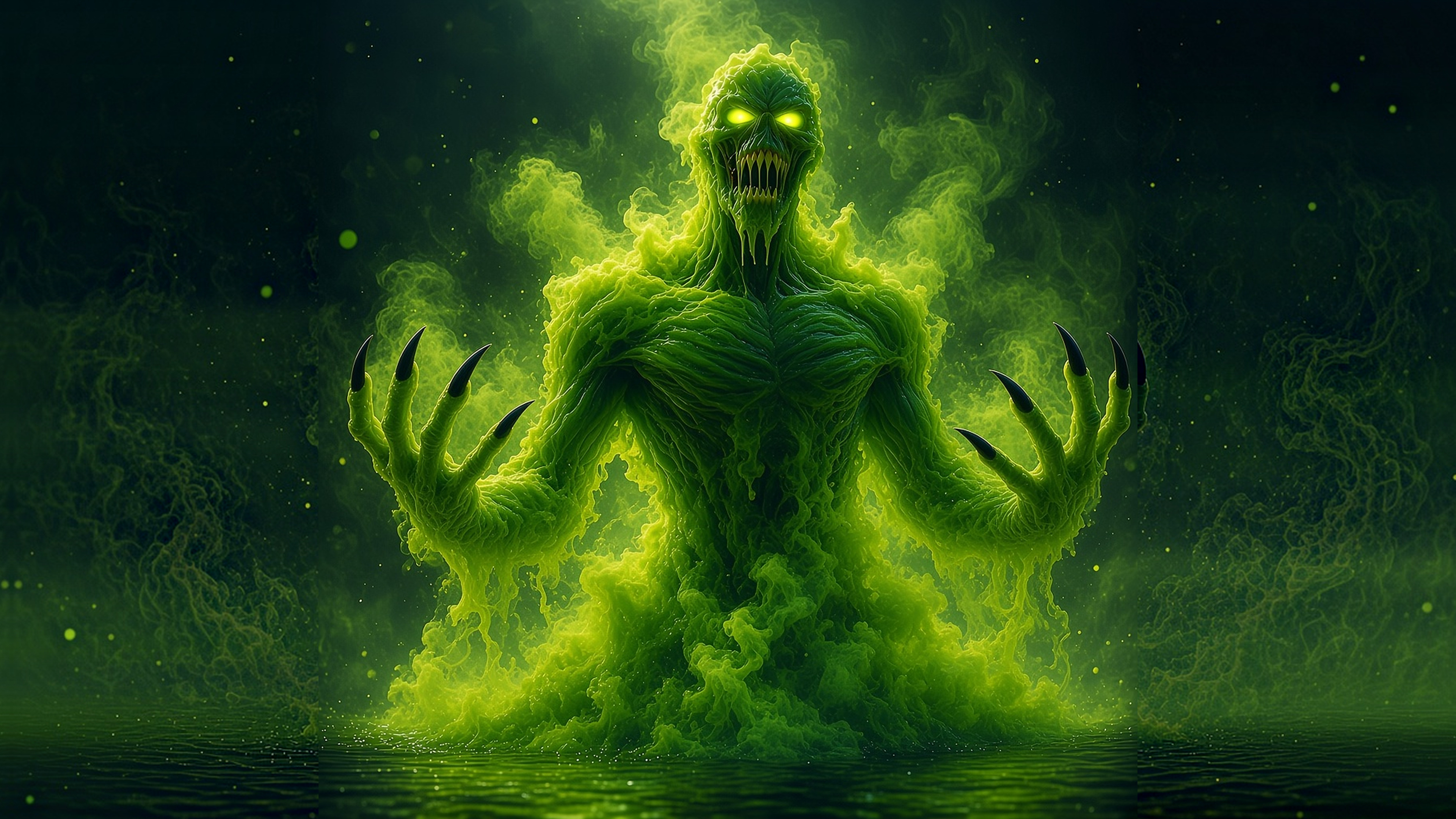
Dry yellow-green chlorine vapor seeps from around the buildings of a bleached futuristic city, rolls into the empty street, and gathers into the Chlorine character.
The science behind the story: real chlorine is a dense, poisonous yellow-green gas and a powerful oxidizer; it is the active agent in household bleach, and because it is heavier than air it forms a low-rolling blanket. The vapor seeping from the buildings and assembling into a character is fiction.
From the Periodic Table Kings files
Written by Terrence Oneal for the original Periodic Table Kings pages.
Chlorine is essential in balancing the acid-base of the blood, in the formation of bones, teeth and tendons. This mineral works only in combination with sodium and potassium. It helps eliminate organic waste. It has depurative action, contributing to the smooth functioning of the liver. No fixed daily doses required (approx. 2-3 g of chlorine procured from 3-5 g of salt), but if your menu contains an average amount of salt, then you do not need supplements.
The main role of chlorine is to form hydrochloric acid in the stomach. In the absence of it, digestion takes place with great difficulty. The activity of this element in the process of digestion begins in the mouth yet, entering in the composition of saliva, which stimulates the secretion of the enzyme ptyalin, participating in starch degradation.
Origin
Chlorine is a greenish-yellow, diatomic, dense gas with a sharp smell (the smell of bleach). It is not found free in nature as it combines readily with nearly all other elements.
Earth’s oceans contain a large amount of chlorine. If this chlorine were released as a gas, its weight would be 5x greater than Earth’s total current atmosphere. (Our oceans contain about 2.6 x 10¹⁶ metric tons of chlorine, mostly as sodium chloride.)
Compounds
Chlorine is also used for the manufacture of chlorates and it is important in organic chemistry, forming compounds such as chloroform, carbon tetrachloride, polyvinyl chloride, and synthetic rubber. Other uses of chlorine compounds include dyestuffs, petroleum products, medicines, antiseptics, insecticides, foodstuffs, solvents, paints and plastics.
Chlorine is used for producing safe drinking water. Chlorinated compounds are used mostly for sanitation, pulp bleaching, disinfectants, and textile processing.
Chlorine is a toxic gas that irritates the skin, the eyes and the respiratory system. Chlorine is heavier than air. When released, it forms a poisonous blanket that drifts along with the wind. Chlorine was used as a chemical weapon in World War I, first in 1915 by the German army and then by the Western Allies. It was not as ‘effective’ as had been hoped, because chlorine is easily detected by its strong smell. It is also water soluble, and so soldiers could protect themselves from the worst of its effects by breathing through damp cloths.
Artwork 1