Lithium
Alkali Metals · Saga species: Alkali Metals
Lithium (from Greek:λίθος lithos, "stone") is a chemical element with the symbol Li and atomic number 3.
Story scene
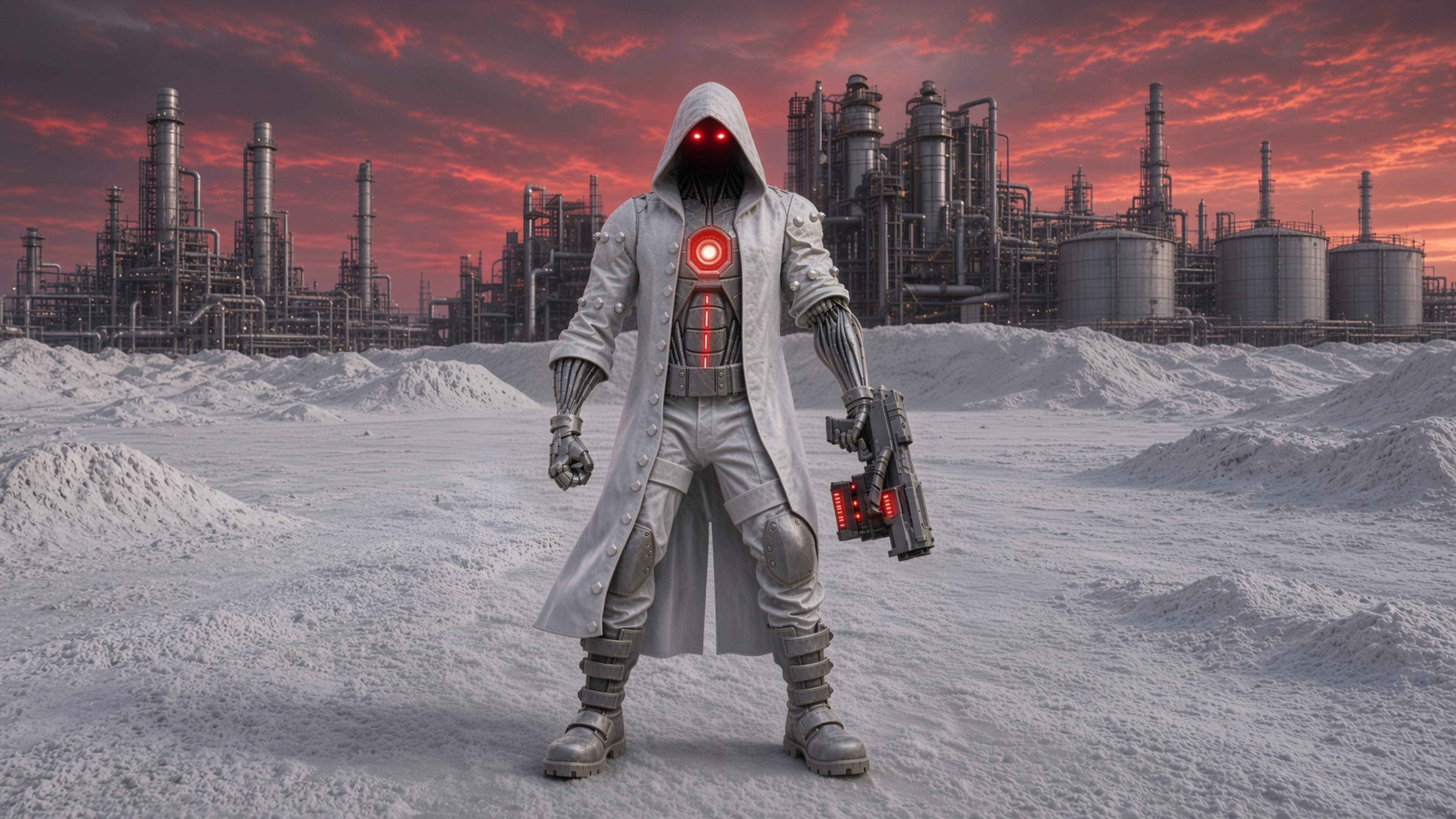
Lithium — Metropolis
Standing before the Lithium metropolis, his crimson eyes glow; he aims his pistol and fires a huge crimson power beam with recoil.
From the Periodic Table Kings files
Written by Terrence Oneal for the original Periodic Table Kings pages.
Lithium is soft and silvery white and it is the least dense of the metals. It is highly reactive and does not occur freely in nature. Freshly cut surfaces oxidize rapidly in air to form a black oxide coating. It is the only common metal (but see radium) that reacts with nitrogen at room temperature, forming lithium nitride.
Lithium burns with a crimson flame, but when the metal burns sufficiently well, the flame becomes a brilliant white. Lithium has a high specific heat capacity and it exists as a liquid over a wide temperature range.
Pure lithium metal is used in rechargeable lithium ion batteries and the metal is used as an alloy with aluminum, copper, manganese, and cadmium to make high performance aircraft parts. Lithium also has various nuclear applications, for example as a coolant in nuclear breeder reactors and a source of tritium, which is formed by bombarding lithium with neutrons.
Lithium carbonate is used as a mood-stabilizing drug. Women taking lithium carbonate for bi-polar disorder may be advised to vary their treatment during pregnancy as lithium may cause birth defects.
Lithium based batteries have revolutionized consumer devices such as computers and cell phones. For a given battery weight, lithium batteries deliver more energy than batteries based on other metals; in other words, lithium batteries have high energy density Lithium is corrosive, causing skin burns as a result of the caustic hydroxide produced in contact with moisture.
The alkali metals include: lithium, sodium, potassium, rubidium, cesium, and francium.
Alkali metals are among the most reactive metals. This is due in part to their larger atomic radii and low ionization energies. They tend to donate their electrons in reactions and have an oxidation state of +1. These metals are characterized by their soft texture and silvery color.
Group 2
Lithium was discovered by the Swedish chemist Johan August Arfwedson in 1817.1 Arfwedson found lithium in the mineral petalite.1 He realized that petalite contained a previously unknown metal, which he named lithium.1 However, he was not able to separate it by electrolysis.1
Some of the lithium we rely on today was created during the Big Bang 13.8 billion years ago.2 Lithium atoms are fragile and typically get destroyed in the burning core of a star.2 The lithium cycle on Earth starts with lithium-bearing magma rising to the Earth’s crust during periods of volcanic activity.1 Over many thousands of years, weathering of the exposed rocks weakens their structure and allows the lithium salts to be washed out and flow into rivers.1 Most of the dissolved lithium is carried to the oceans.1 However, in some high mountainous regions, such as the South American Andes, the rivers don’t reach the ocean but instead end in closed basins where the water evaporates, leaving behind lithium-enriched brine contained in salt flats or salars.1 Other sources of lithium include oilfield brines, geothermal brines, and clays.1 Lithium is not scarce but as it is highly reactive it is never found in its pure form in nature.1 Lithium is the 33rd most abundant element in the Earth’s crust with an estimated 98 million tonnes.1 These early observations and the discovery of lithium have paved the way for its wide range of applications today, from rechargeable batteries to medicinal uses.1
The name “lithium” comes from the Greek word “lithos,” meaning “stone,” reflecting its presence
Lithium, represented by the symbol Li, is a soft, silvery-white alkali metal with some unique physical and chemical properties: (1)(2)
It is the lightest of the metals, with a density approximately half that of water. (1)
Under ordinary conditions, lithium is the least dense of the solid elements. (1)
Lithium imparts a crimson color to flame, although the metal itself burns a bright white. (1)
It is used as an alloying agent, in synthesizing organic compounds, and is added to glasses and ceramics. (1)
Its high electrochemical potential makes it useful for battery anodes. (1)
Lithium chloride and lithium bromide are highly hygroscopic, so they are used as drying agents. (1)
Please note that these properties can change under different conditions, such as temperature or chemical reactions. Always handle lithium and its compounds with care, as they can be reactive.
Unique Properties
Lithium, the third element in the periodic table, has several unique properties that make it stand out. Here are some of them:
Lithium is the lightest metal and has the lowest density of any metal 1. It’s so light that it can float on water. (1)
Lithium is highly reactive. It reacts with water, but not as vigorously as sodium. (2) It also reacts with nitrogen at room temperature, forming lithium nitride. (3)
Lithium’s electron configuration is [He] 2s¹, indicating that it has one electron in its outermost shell. This makes lithium highly reactive as it readily gives up its lone outer electron to achieve a more stable electron configuration. (4)
This means it can absorb a lot of heat before it gets hot, a property that’s useful in a variety of applications.
Lithium and its compounds have a wide range of applications, including in rechargeable batteries, as an alloy additive to aluminum and magnesium to lower weight and improve strength, (1) and in the production of ceramics and glasses. (5)
Remember, due to its high reactivity, lithium is usually stored in oil to prevent it from reacting with the moisture in the air. (1)
When exposed to flame, lithium and its compounds impart a crimson color. (2)(3)
Please note that these colors can change under different conditions, such as temperature or chemical reactions. Always handle lithium and its compounds with care, as they can be reactive.
Production
Lithium, often dubbed as “white gold” for electric vehicles, is a lightweight metal used in the cathodes of lithium-ion batteries, which power electric vehicles. (1) The demand for lithium has increased significantly due to the growing demand for electric vehicles.
This method is used in Chile, where lithium is extracted from brines, salty liquid found at the Earth’s surface or underground. The liquid is pumped from the earth and then placed in pools where the water can evaporate, leaving behind lithium and other elements. (2)
This method is used in Australia, where lithium is extracted from a lithium-rich mineral called spodumene2. Australia produces roughly half of the globe’s supplies. (2)
The three largest producers of lithium are Australia, Chile, and China (1) . Australia alone produces 52% of the world’s lithium. (1) China, the third-largest producer, has a strong foothold in the lithium supply chain. (1)
Global lithium production has grown from about 37,000 tonnes a decade ago to 130,000 tonnes in 2022 (2) , and reached a new high of 180,000 metric tons in 2023. (3) The demand for lithium is expected to reach 1.5 million tonnes of lithium carbonate equivalent by
Both brine and hard rock mining come with environmental and social costs. (2) Mining of all kinds can disturb landscapes and require significant water use, a resource that may be scarce in certain mining regions. (2) Brine mining, which largely uses energy from the sun, is much less intensive than hard rock mining, which requires heavy machinery to dig up and crush rock. (2)
Compounds
Lithium, a highly reactive alkali metal, forms a variety of compounds. (1)
This is one of the most important lithium compounds and is used in the production of lithium-ion batteries, ceramics, and glass. (3)
This compound is used in air purification systems, as well as in the production of lithium greases and lubricants. (3)
These compounds have a wide range of applications, including use in batteries, ceramics, glass, and pharmaceuticals. (3)(4) Lithium compounds are also used in the treatment of bipolar disorder and other mental health conditions. (3)
Reactivty & Toxicity
Lithium is a highly reactive alkali metal. Here’s some information about its reactivity and toxicity
Lithium is part of the Group 1 Alkali Metals, which are highly reactive and are never found in their pure form in nature. (1)
Lithium’s lower reactivity compared to other alkali metals is due to the proximity of its valence electron to its nucleus. (2)
It reacts slowly with water at room temperature and more rapidly at higher temperatures. (3)
It does not react with oxygen at room temperature, but above 100°C, it reacts to form lithium oxide (Li₂O). (3)
Lithium toxicity, also known as lithium overdose, occurs when you have too much of the prescription medication lithium in your body. (4)
Symptoms of lithium toxicity can include gastrointestinal symptoms like vomiting and diarrhea, and neurological symptoms like confusion and uncontrolled shaking. (4)
Severe lithium toxicity can lead to heightened reflexes, seizures, agitation, slurred speech, kidney failure, rapid heartbeat, hyperthermia, uncontrollable eye movements, low blood pressure, confusion, coma, delirium, and even death. (5)
Lithium toxicity is a life-threatening condition that requires immediate medical care in a hospital. (4)
Healthcare providers check lithium levels with a blood test. In general, levels of lithium toxicity include:
If you or someone else is showing symptoms of lithium toxicity, seek immediate medical attention. It’s important to remember that this information is intended for general knowledge and is not a substitute for professional medical advice or treatment. Always consult with a healthcare provider for any health-related concerns.
Isotopes
Naturally occurring lithium is composed of two stable isotopes: lithium-6
It makes up about 4.85% of the naturally occurring lithium. (1) It has a large neutron-absorption cross section, and when bombarded with neutrons, tritium is produced.
This isotope is far more abundant, making up about 95.15% of the naturally occurring lithium1. (2) It is used in the molten lithium fluoride of molten salt reactors and to alkalize coolant in pressurized water reactors. (3) It also shows a nuclear magnetic resonance effect. (1)
In addition to these stable isotopes, there are several radioisotopes of lithium. The longest-lived radioisotope is lithium-8 (8 Li), which has a half-life of just 838.7 milliseconds1. Other isotopes include lithium-9 (9 Li) with a half-life of 178.3 milliseconds, and lithium-11 (11 Li) with a half-life of 8.75 milliseconds. (1) All of the remaining isotopes of lithium have half-lives that are shorter than 10 nanoseconds. (1)
The isotopes of lithium separate somewhat during a variety of geological processes, including mineral formation (chemical precipitation and ion exchange). Lithium ions replace magnesium or iron in certain octahedral locations in clays, and lithium-6 is sometimes preferred over lithium-7.
This results in some enrichment of lithium-6 in geological processes. (1)
Artwork 1
Sources from Terrence’s reference notes
Lithium History
- 1 lithium.org
- 2 lithium.org
- 3 w.astro.berkeley.edu
- 4 physicsworld.com
Lithium Production
- 1 weforum.org
- 2 climate.mit.edu
- 3 statista.com
- 4 thoughtco.com
- 5 pubs.usgs.gov
- 6 gettyimages.com
Lithium Properties
- 1 thoughtco.com
- 2 thechemicalelements.com
- 3 britannica.com
- 4 melscience.com
Lithium Unique Properties
- 1 sciencenotes.org
- 2 thoughtco.com
- 3 chemicool.com
- 4 chemistrycool.com
- 5 britannica.com
Lithium Properties/Colors
- 1 en.wikipedia.org
- 2 britannica.com
- 3 thoughtco.com
- 4 colorwithleo.com
- 5 gettyimages.com
Lithium Compounds
- 1 en.wikipedia.org
- 2 examples.com
- 3 en.wikipedia.org
- 4 techiescience.com
- 5 gettyimages.com
Lithium Reactivity & Toxicity
- 1 chem.libretexts.org
- 2 en.wikipedia.org
- 3 chemistryexplained.com
- 4 my.clevelandclinic.org
- 5 healthline.com
- 6 en.wikipedia.org
- 7 goodrx.com
- 8 britannica.com
- 9 britannica.com
Lithium Isotopes
- 1 en.wikipedia.org
- 2 en.wikipedia.org
- 3 thoughtco.com
- 4 chemeurope.com