Radon
Radon is a chemical element with symbol Rn and atomic number 86.
From the Periodic Table Kings files
Written by Terrence Oneal for the original Periodic Table Kings pages.
Radon is a colorless, odorless, and flavorless gas at ordinary temperature and pressure. Radon is highly radioactive and a carcinogen. Its decay products are toxic and radioactive. Radon is present in most homes. Radon occurs in nature as the decay product of uranium, radium, thorium, and other radioactive elements. There are 33 known isotopes of radon. Rn-226 is the most common of these. It is an alpha emitter with a half-life of 1601 years. None of the isotopes of radon are stable.
Radon is the second leading cause of lung cancer overall (after smoking) and the leading cause of lung cancer in non-smokers. Some studies link radon exposure to childhood leukemia. Radon was used for treating cancer by radiotherapy. Safer treatments are now available.
Radon is a noble gas, which means it has a stable outer electron shell. For this reason, radon does not readily form chemical compounds. The element is considered chemical inert and monatomic. However, it has been known to react with fluorine to form a fluoride. Radon clathrates are also known. Radon is one of the densest gases and is the heaviest. Radon is 9 times heavier than air. Radon is present in the Earth's crust at an abundance of 4 x10-13 milligrams per kilogram. It is always present outdoors and in drinking water from natural sources, but at a low level in open areas. It's mainly a problem in enclosed spaces, such as indoors or in a mine.
Radon is a colorless, odorless, and flavorless gas at ordinary temperature and pressure. Radon is radioactive and decays into other radioactive and toxic elements. Radon occurs in nature as the decay product of uranium, radium, thorium, and other radioactive elements. There are 33 known isotopes of radon. Rn-226 is the most common of these. It is an alpha emitter with a half-life of 1601 years. None of the isotopes of radon are stable.
Radon is present in the Earth's crust at an abundance of 4 x10-13 milligrams per kilogram. It is always present outdoors and in drinking water from natural sources, but at a low level in open areas. It's mainly a problem in enclosed spaces, such as indoors or in a mine.
Radon Radon is the second leading cause of lung cancer overall (after smoking) and the leading cause of lung cancer in non-smokers. Some studies link radon exposure to childhood leukemia.
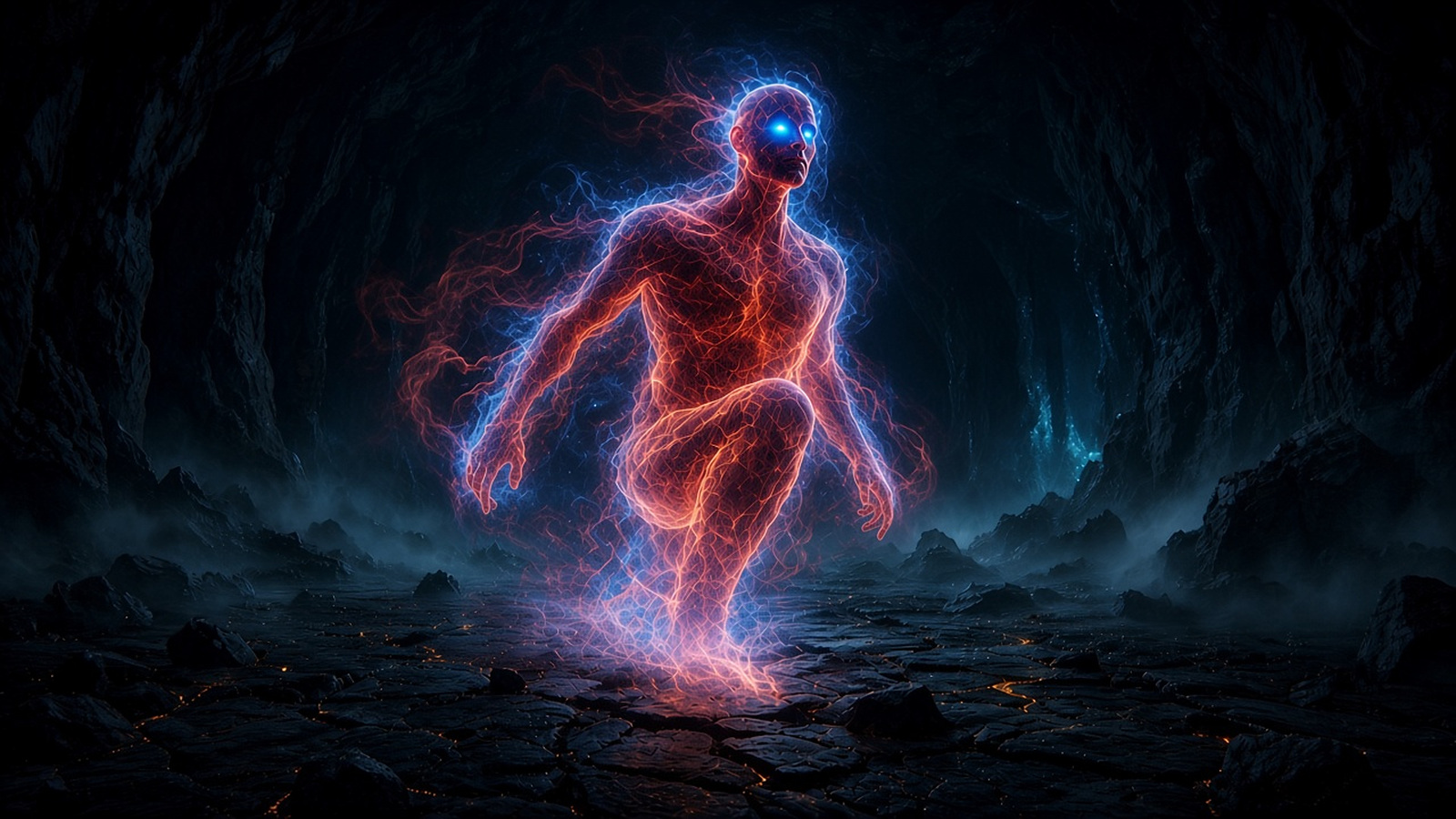
Cavern Decay Pulse
Radon is a radioactive noble gas produced by radium decay. In an initially empty dark cavern, cyan fissures vent blue radiation-like vapor. His translucent red-orange gaseous body rises vertically from below the ground, head and shoulders emerging first, followed by torso and legs, while blue radiation continuously escapes from the fissures and his body. He finishes fully emerged and hovering, his eyes bright cyan-blue.
Artwork 14


