Sodium
Alkali Metals · Saga species: Alkali Metals
Sodium /ˈsoʊdiəm/ is a chemical element with symbol Na (from Ancient Greek Νάτριο) and atomic number 11.
Story scene
Sodium — Ascension
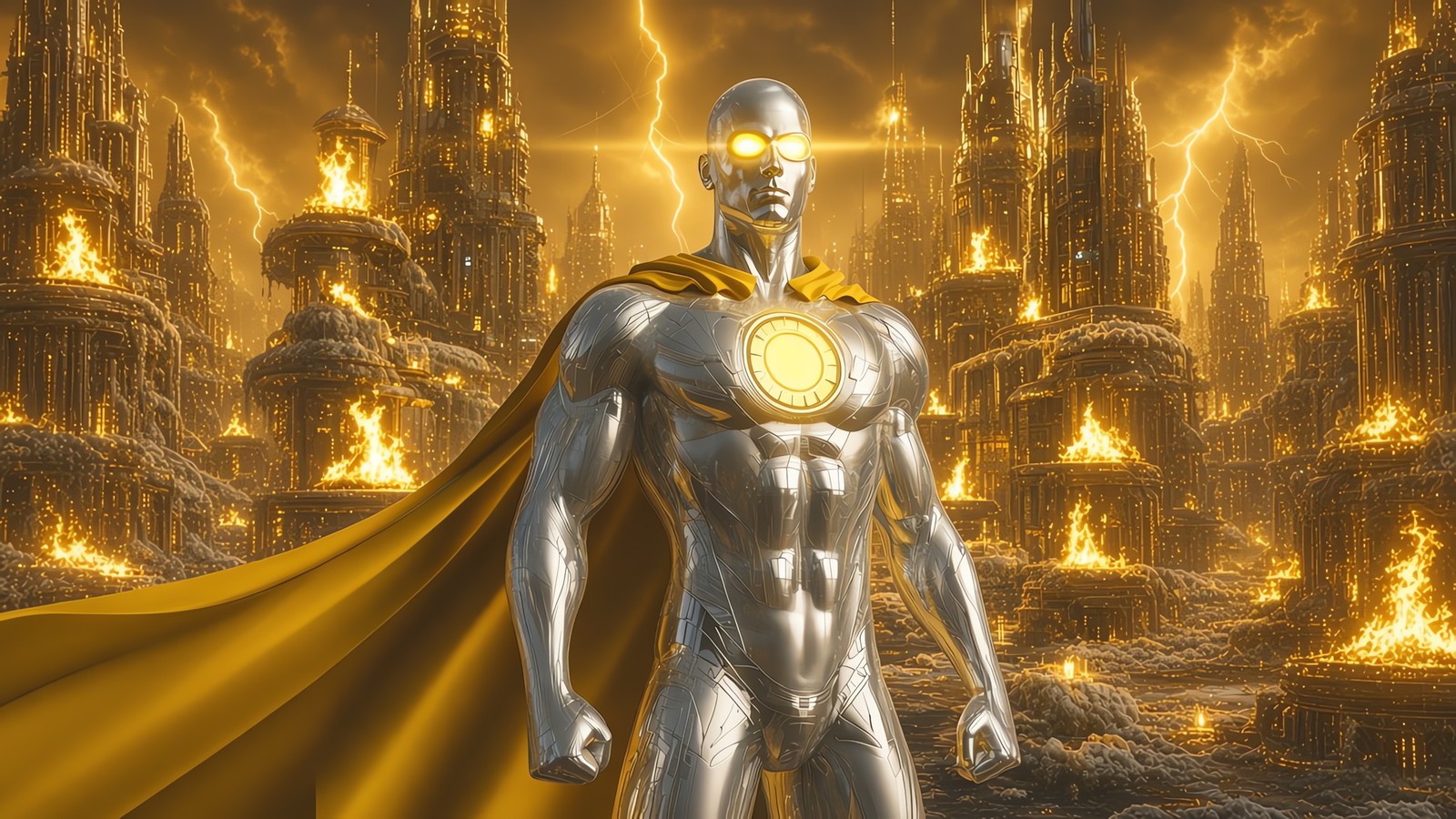
Silver metallic Sodium, with glowing yellow eyes, a glowing chest circle and a yellow cape, stands among an army of rocky monsters under a stormy golden-brown sky over futuristic golden towers. He levitates as they surge below, and his body transforms into radiant golden energy.
The science behind the story: real sodium is a soft, silvery alkali metal that burns with an intense yellow flame, the 589 nm yellow of sodium lamps. The character levitating and transforming into golden energy is fiction.
From the Periodic Table Kings files
Written by Terrence Oneal for the original Periodic Table Kings pages.
Sodium is one of the body's electrolytes, which are minerals that the body needs in relatively large amounts. Electrolytes carry an electric charge when dissolved in body fluids such as blood. (See also Overview of Electrolytes.)
Most of the body’s sodium is located in blood and in the fluid around cells. Sodium helps the body keep fluids in a normal balance (see About Body Water). Sodium plays a key role in normal nerve and muscle function.
The body obtains sodium through food and drink and loses it primarily in sweat and urine. Healthy kidneys maintain a consistent level of sodium in the body by adjusting the amount excreted in the urine. When sodium consumption and loss are not in balance, the total amount of sodium in the body is affected. The amount (concentration) of sodium in the blood may be Too low (hyponatremia), Too high (hypernatremia)
Sodium is a soft, silvery-white metal. Sodium is considered to be non-toxic. Sodium burns in air with a brilliant yellow flame. It is soft enough to cut with the edge of a coin. Sodium floats on water, because its density is lower than water’s. It also reacts vigorously with water – violently if more than a small amount of sodium meets water.
Sodium is our planet’s sixth most abundant element and it is the most abundant alkali metal. If all the sodium chloride (table salt) in the oceans could be extracted and dried, it would cover the entire surface of the USA to a depth of almost a mile and a half (about 2.3 km). The same salt could cover all the land on Earth to a depth of almost 500 feet (150 m).
Humans and other animals need sodium to maintain the correct fluid balance in their cells. Sodium chloride (table salt, NaCl) is vital for good nutrition. Sodium ions facilitate transmission of electrical signals in the nervous system and regulate the water balance between body cells and body fluids. An immediate effect of low sodium can be seen in heat cramping, when athletes’ muscles seize up after exertion. Heat cramping is caused by the loss of sodium ions when salt is removed from the body in sweat.
Sodium is used as a heat transfer agent; for example, liquid sodium is used to cool nuclear reactors. Metallic sodium is used in the manufacture of sodamide and esters, and in the preparation of organic compounds. The metal also may be used to modify alloys such as aluminum–silicon by improving their mechanical properties and fluidity.
Sodium is used to descale (smooth the surface of) metals and to purify molten metals. Sodium is produced in heavy stars, mainly when atoms of neon gain a proton. (The neon atoms were themselves produced by carbon atoms coming together in nuclear fusion reactions.).Due to its high reactivity, sodium is found in nature only as a compound and never as the free element. . Sodium is obtained commercially by electrolysis of molten sodium chloride.
Sodium and its close periodic table neighbor potassium are solids at room temperature. Their alloys however are not. NaK alloys containing 10 to 60 percent of sodium by weight are liquids at room temperature.
Sodium reacts with water more vigorously than lithium and less vigorously than potassium. Explosions occur when the heat generated by the sodium-water reaction ignites the resulting hydrogen gas. Contact with the skin may cause irritation and burns.
Artwork 1